Mind the boundaries, Tech Insiders.
Apple is bringing touch to new MacBook Pro models, campaigns are courting chatbots, and Dutch officials are planning a smaller workforce before publishing detailed AI productivity plans. Let's see where the lines are moving. |
|
|
|
Here's what you need to know today: |
|
|
|
The MacBook Pro Finally Gets Touchy |
Apple has finally approved fingers for professional use.
Apple unveiled its first touchscreen MacBook Pro yesterday, pairing a PROLED XDR display with M5 Pro or M5 Max chips. The 14-inch starts at a hefty $2,899; the 16-inch at $3,399. Maxing out the specs pushes those numbers to an absurd $14,249 and $14,549, respectively—just in case you were deciding between a new Mac and a decent used car. Preorders are open, with availability beginning Nov. 6.
After years of insisting that poking a laptop screen is ergonomically terrible, Apple has suddenly seen the light. Its new philosophy? Keep the keyboard central, fatten the menus for clumsy digits, and stiffen the hinge to stop screen wobble. The long-standing philosophical objection now comes with a shipping date. |
Early testers are drooling over the screen while mostly shrugging at the touch input. Ars Technica's Samuel Axon praised the absolute blacks but noted that pawing the display mostly duplicates trackpad gestures. WIRED's Steven Levy admired the visuals and noticed UI elements politely enlarging for fingers.
The caveats? It isn't a convertible, and the Apple Pencil is strictly forbidden. While macOS generously interprets taps as basic mouse clicks, true touch-first optimizations are still rolling out. Apple's Creator Studio patch lands in November, with third-party developer updates dragging in by year's end.
Why it matters: Apple is blurring the sacred boundary between Mac and iPad while preserving desktop workflows. For creative pros, the gorgeous OLED panel might justify the massive upgrade tax before the touch features ever do; test your apps before expensing Apple's sudden change of heart.
|
|
|
|
Would you pay extra for a touchscreen MacBook Pro? |
|
|
|
Results from Yesterday's Pulse Check |
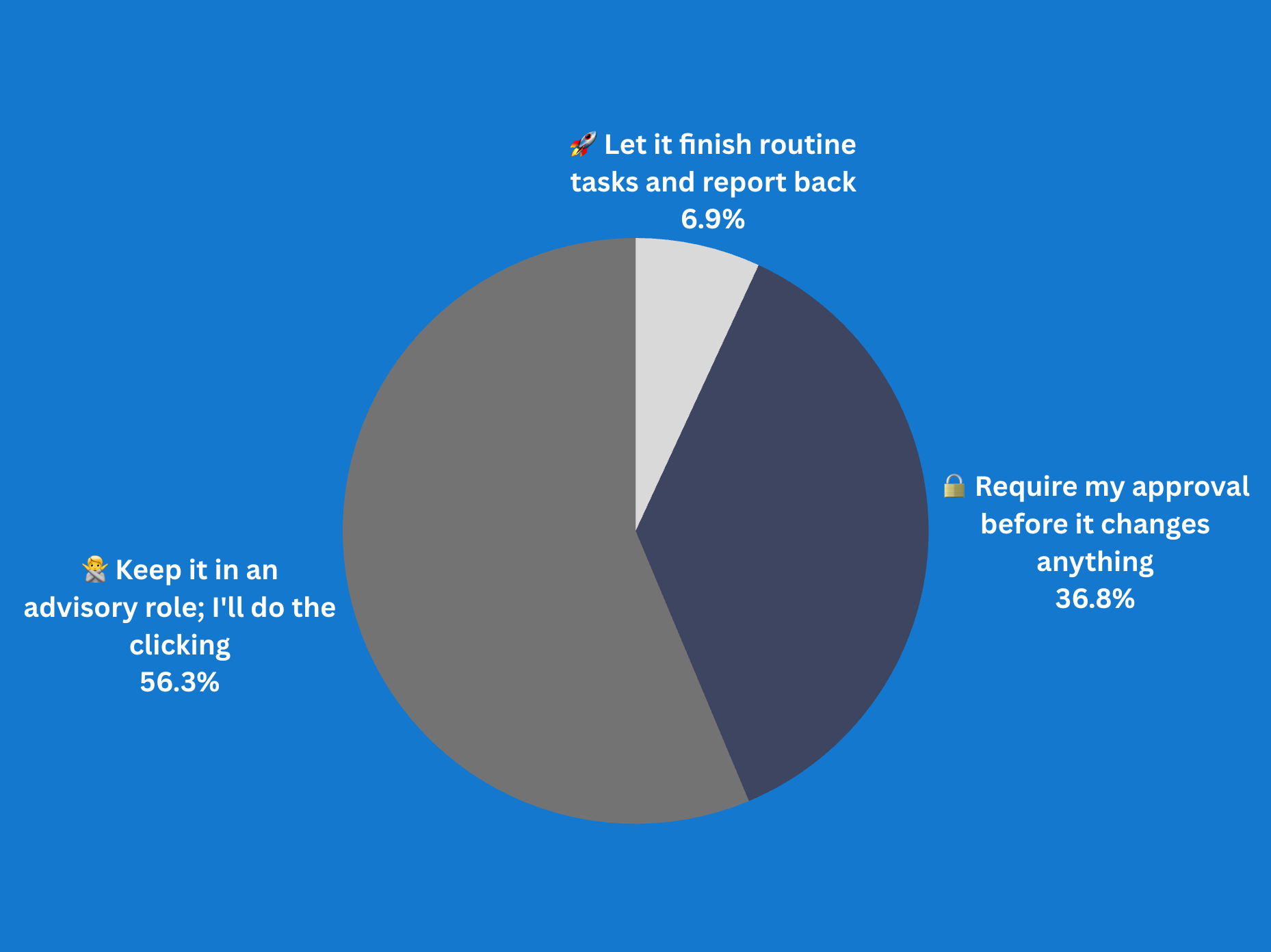
A cheaper, faster AI can work across your business apps. How much freedom would you give it? |
|
|
|
Move Less, Achieve More: A Workload-Based Data Strategy for Enterprise AI |
Enterprise AI depends on getting trusted data to the right workload without creating unnecessary copies. See how a workload-based data strategy can reduce data movement while giving IT teams more control as AI projects move into production. |
|
|
The Midterms Have an AI Verification Problem |
Image created with ChatGPT |
In a frantic bid to keep things sane, OpenAI is launching an election war room and forcing ChatGPT to render election-interference prompts as goofy cartoons. CNET found the protection held; Gizmodo easily found a bypass by simply asking for photorealism. Clearly, Big Tech's safeguards are more like speed bumps than brick walls.
It's not all doom and gloom. An Election Assistance Commission guide documents AI-assisted notices, training, and poll-worker scheduling to help swamped local offices. The catch? "The chatbot ate my homework" doesn't hold up in election law, so humans still have to check the outputs. Separately, an attempted hack triggered the FEC's electronic-filing shutdown, abruptly blinding the public to late-stage campaign finance disclosures. While no AI link is established—and actual ballot counting is entirely unaffected—it proves transparency is fragile right when we need it most. Bottom line for voters? Double-check your deadlines and polling places with actual human election officials. For everyone deploying AI, preparation means constantly checking outputs and controlling actions, not just applauding corporate safety announcements. Your chatbot doesn't get a vote. Don't give it yours. |
|
|
|
Growth can expose operational gaps MSPs could once work around. Onboarding friction, audit demands, unused licenses, and difficulty communicating value can become increasingly important as providers scale.
Join Channel Insider and Nerdio on Nov.5, 2026, at 1:00 p.m. ET for The MSP Efficiency Gap: What Separates Scalable Providers From the Rest, and explore what Nerdio's research reveals about scalable MSP operating models. |
|
|
Authenticator Gets an Identity Check |
Microsoft has patched CVE-2026-80097 in Authenticator for Android, because the app designed to verify identities was letting malicious apps steal work account tokens with a simple fake mustache.
Enclave's test app needed no Android permissions to impersonate installed Microsoft apps and waltz away with email, file, and calendar access. Authenticator knew the real caller's identity but blindly trusted the supplied disguise instead. |
Image created with ChatGPT |
Exploitation requires a rogue app running on the phone. Enclave reported no additional interaction, though Microsoft says a sign-in step is required. Microsoft's September advisory listed no exploitation.
Update through Google Play to version 6.2606.4246 or later; IT teams should enforce that minimum before your broker hands out VIP passes to the wrong crowd. An awkward place for an identity crisis. |
44 AI Agents, Same Old Security Holes |
eSecurity Planet reports that TrendAI examined three attack infrastructures targeting Japanese organizations, finding AI playing roles from coding assistant to automated overlord.
The overachiever of the bunch used CyberStrikeAI's 44 agents to probe at least 19 organizations, including 16 in Japan. Despite all that next-gen firepower, only a handful suffered deep compromises. The worst breach literally walked through a wide-open, password-free admin portal. So much artificial intelligence, so little natural resistance. Defenders need to patch legacy systems, dump default credentials, and lock down admin interfaces. Keep an eye out for low-frequency probes, since the platform sneaks around by throttling traffic to individual targets. The attackers automated their hacking. Your patch backlog remains stubbornly yours. |
|
|
|
🏗️ Build an AI-Ready Workplace Explore expert insights and practical guidance to modernize workplace technology, strengthen security, and prepare your organization for AI-powered work. Explore the hub.
💾 Clone Your Windows Drive Without Starting Over
Transferring data between PCs, migrating operating systems, and more is easy with a lifetime license to EaseUS Disk Copy, now half off at just $29.99.
🎙️ Give Your Keyboard a Break With AI Dictation
Ditch the typing with a VoiceType AI Voice-to-Text: Lifetime Subscription and dictate up to 5,000 words per month across desktop apps, with smart punctuation, grammar corrections, and lifetime access without recurring subscription fees.
💻 This section contains sponsored tech insights. Advertise with us! |
|
|
|
25,000 Job Cuts, AI Details to Follow |
The Netherlands is trimming the bureaucratic fat, planning to cut roughly 25,000 full-time government jobs over the next decade in an AI-led efficiency crusade. The goal? Pocketing €900 million (about $1 billion) in 2027 and €3.5 billion (roughly $3.9 billion) annually by 2035. Police and defense are being spared the algorithmic ax. Exactly how this digital utopia will function remains a mystery, with official AI blueprints not arriving until early 2027. Which systems will handle the grunt work—and whether this means brutal layoffs or just natural attrition—is anyone's guess. For now, the budget spreadsheet is leading the charge.
This overhaul goes beyond slapping a chatbot on a public website. Officials want to slash 500 regulations annually, standardize IT, and force agencies to finally share data. Even physical office furniture isn't safe—the government is mandating a game of musical chairs with a target of one workstation per two employees. |
Image created with ChatGPT |
While dire for civil servants, Channel Insider notes this could be a goldmine for technology partners. But the invisible costs of babysitting those algorithms—licensing, endless integration, and human oversight—will undoubtedly chew into those projected savings. Slashing headcount doesn't magically guarantee cheaper government operations.
Then there's the inevitable workload boomerang. A recent Bloomberg analysis highlights "agentic flooding," where citizens use their own AI to mass-generate complaints. Automating the clerk behind the counter is essentially pointless if the public automates the mountain of paperwork thrown at them. Success ultimately hinges on whether citizens can get human help when the bots inevitably break.
Apparently, bureaucracy is perfectly capable of scaling on both sides of the desk. |
|
|
|
|
Writer/Editor at TechnologyAdvice |
Justin Meyers is an investigative writer and editor who draws on over a decade of meticulous hands-on research to deliver the full, trustworthy story behind consumer and enterprise tech, including cybersecurity. |
|
|
|
Curious about where AI is really headed? |
The Neuron cuts through the noise to bring you smart, hype-free takes on the latest AI trends, tools, and breakthroughs. Join 700,000+ professionals from top companies like Microsoft, Apple, Salesforce, and more.
|
|
|
|
Advertise in Daily Tech Insider! Daily Tech Insider is a TechnologyAdvice business. © 2026 TechnologyAdvice, LLC. All rights reserved.
TechnologyAdvice, 3343 Perimeter Hill Dr., Suite 215, Nashville, TN 37211, USA. |
|
|
|
|