Token showdown, Tech Insiders.
Anthropic fired the first shot by gutting Claude's rates, and OpenAI is now eyeing the trigger on a matching markdown. Picture a high-noon discount duel as CFOs and cloud vendors scramble for cover. Strap in before the savings stampede starts. |
|
|
|
Here's what you need to know today: |
|
|
|
OpenAI Eyes Token Price Slashes to Outflank Anthropic |
Because even AI giants know tokens don't grow on trees.
OpenAI is weighing steep cuts to the per-token prices it charges for ChatGPT and its APIs, according to a Wall Street Journal scoop this past Wednesday, as it braces for a looming price war with fast-rising rival Anthropic. The company reportedly expects Anthropic to trim Claude fees too, after enterprises began capping ballooning AI bills and complaining about tokenmaxxing—like Uber, which just capped usage at $1,500 per tool per month.
CEO Sam Altman admits costs are now "a huge issue." Deep discounts could squeeze margins just as both companies prepare IPOs; Anthropic recently leapfrogged OpenAI's valuation (hitting $965 billion against OpenAI's $852 billion) and logged a fivefold revenue jump on the viral success of its coding assistant Claude Code, while OpenAI is racing to revive Codex.
|
Image created with ChatGPT |
The gambit follows Anthropic's 67% price cut for Claude Opus last November and Google's new $4.99 Gemini Plus tier, underscoring industry-wide pressure to make AI cheaper.
Analysts warn a markdown could double token traffic yet still leave businesses struggling to prove ROI, especially since 95% of enterprise generative AI pilots currently deliver zero measurable profit within six months. Why it matters: Your CFO might finally stop side-eyeing the monthly AI bill—or ask harder questions when the discounted tokens start flowing faster than ever, and the bottom line still doesn't budge. |
|
|
|
If OpenAI slashes token prices, how will your team respond? |
|
|
|
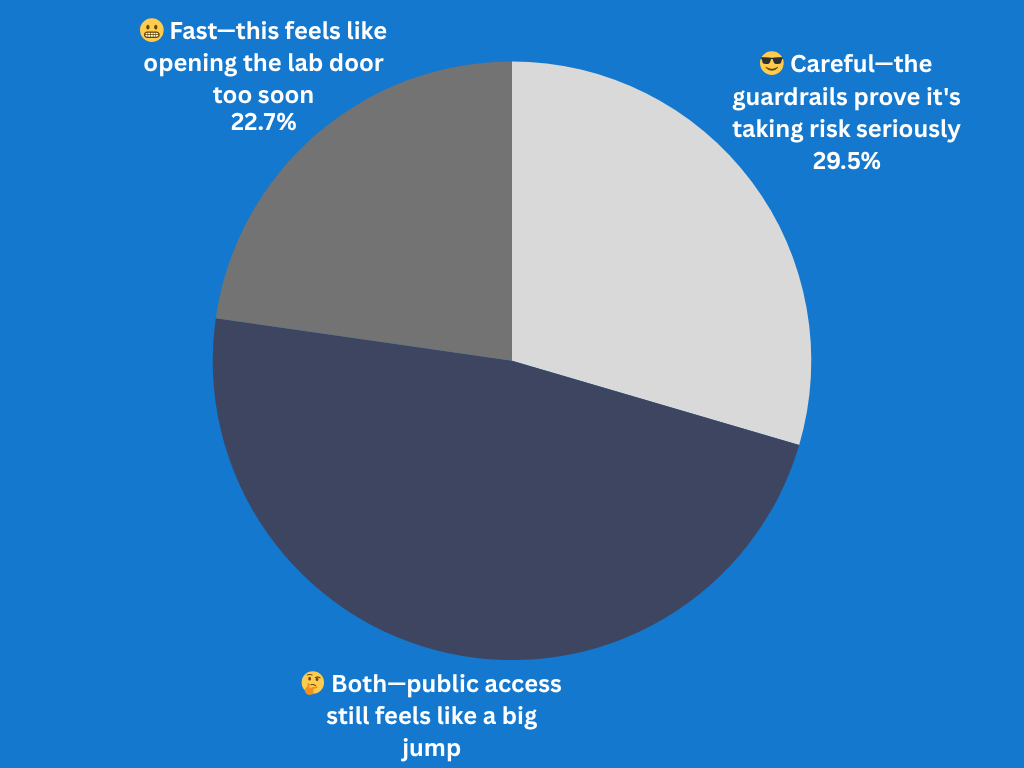
Results from Yesterday's Pulse Check |
Is Anthropic moving fast or being careful with Fable 5? |
|
|
|
Coinbase Opens Wallets to AI Agents |
Because bots gotta pay rent, too.
Yesterday, Coinbase rolled out Coinbase for Agents, a new account type that lets AI assistants such as ChatGPT or Claude trade crypto and pay for premium data on your behalf.
Available via an MCP server for web interfaces or a CLI for developer terminals, the integration links to a user-approved portfolio (or a sandbox). There, it can rebalance holdings, place spot or derivatives orders, and soon branch into equities and prediction markets. |
Under the hood, Coinbase's open x402 protocol lets the agent buy research, APIs, or on-demand compute with stablecoins like USDC, skipping logins and subscription hoops. Users set caps on trade size, spending, and service access, and every move still runs through Coinbase's KYT (Know Your Transaction) compliance screens. Coinbase, naturally, cashes in on the resulting trading fees and Base network transaction volume.
If that sounds wild, remember Coinbase already embeds an SEC- and CFTC-registered Coinbase Advisor agent in its main app for in-house recommendations. The new launch simply hands third-party bots the keys.
The move follows Robinhood's beta for agent-driven stock trades and credit cards, marking a sprint toward agentic commerce that global regulators now say needs strong safeguards. Just keep the bot away from meme coins at 3 a.m.
|
|
|
|
📊 Level Up Your AI With Data Smarts
Why Data Science Matters More Than Ever in the Age of AI breaks down the data science essentials fueling today's smartest models—read it to sharpen strategy and outpace rivals.
📈 Boost Workflow With Lifetime AI Assistant
DeskSense AI Assistant - Pro Plan: Lifetime Subscription unlocks 144 million monthly AI credits, 80 monthly image generations, and 40+ writing templates for a one-time $98—letting you automate content, code, and emails forever.
💡 Level Up Projects With Top PM Picks
5 Best Project Management Software for 2026 compares monday.com, Asana, Wrike, and more, so you can match features, pricing, and integrations to your team's workflow before committing. 💻 This section contains sponsored tech insights. Advertise with us! |
|
|
|
Tchap Breach Exposes French Gov Chat Rooms |
Image created with ChatGPT |
Ironically, France banned foreign apps like WhatsApp and Signal in 2025 for security. Yet, "misere" allegedly gained access by social engineering an education account and striking gold: hardcoded LDAP (internal directory) credentials left in a public PowerShell script by a tax official.
Digital affairs directorate DINUM and national cyber agency ANSSI blocked the rogue account, notified privacy watchdog CNIL, and are auditing logs. Tchap, mandatory for France's 825,000 registered civil servants, rides the open-source Matrix protocol, but this exposure was pure human error, not a protocol flaw. Civil servants should avoid posting sensitive material in public rooms; admins elsewhere should enforce MFA and isolate public channels. Pro tip: Encrypted doesn't help if you post admin credentials in the lobby. |
Record Fine Slams Coupang Over 37M-User Breach and Illegal Tracking |
South Korea's privacy watchdog fined e-commerce giant Coupang a record 624.7 billion won ($409 million) on Thursday. While most of that penalty was for the 2025 data leak that exposed personal info on about 37 million customers—about two-thirds of the country—regulators also tacked on a massive fine for unlawfully tracking the online activity of 11 million users across third-party sites without consent.
Regulators said a former developer kept an authentication key after quitting, letting them siphon names, phone numbers, addresses, and order history for nearly a year. They blasted Coupang for failures in basic safety measures and for delayed breach disclosure.
Coupang will appeal, but it's already on the hook for a nearly 1.7 trillion-won (about $1.1 billion) voucher program. If you've ever ordered from the so-called "Amazon of South Korea," reset your password, watch out for delivery-note phishing, and consider scrubbing saved addresses.
At least the actual Amazon can relax—this headline isn't theirs. |
Visa Hooks ChatGPT Into Its Payment Rails |
Visa and OpenAI will link the card giant's network to ChatGPT agents, allowing bots to find products, pass tokenized card details, and complete purchases inside user-set spending caps and approval rules.
Visa will handle real-time authorization, fraud monitoring, and chargebacks, while OpenAI bakes the checkout flow into ChatGPT and its Codex coding agents.
The pair pitches it as the missing infrastructure for "agentic commerce"—think Alexa-style shopping, but everywhere Visa is accepted, not just Amazon. Hopefully, it fares better than OpenAI's Instant Checkout, a previous shopping feature that was quietly dragged behind the shed in March after merchants balked at its 4% fees.
|
The move marks a payments land grab: Mastercard rolled out a similar Agent Pay toolkit last year, and smaller fintechs are racing to become the default wallet for AI shoppers.
For retailers and devs, Visa's APIs could tap a new wave of agent-initiated orders; for banks, it means adjudicating disputes when a chatbot, not a human, clicks buy by mistake. Key questions linger over fees, privacy, and who eats a refund when the bot botches an order, but Visa says guardrails like merchant allowlists and per-transaction limits will keep consumers in control.
Next time your card pings, check whether it was you or your chatbot buying socks on the company dime. |
|
|
|
| Writer/Editor at TechnologyAdvice |
Justin Meyers is an investigative writer and editor who draws on over a decade of meticulous hands-on research to deliver the full, trustworthy story behind consumer and enterprise tech, including cybersecurity. |
|
|
|
Curious about where AI is really headed? |
The Neuron cuts through the noise to bring you smart, hype-free takes on the latest AI trends, tools, and breakthroughs. Join 700,000+ professionals from top companies like Microsoft, Apple, Salesforce, and more.
|
|
|
|
Advertise in Daily Tech Insider! Daily Tech Insider is a TechnologyAdvice business. © 2026 TechnologyAdvice, LLC. All rights reserved.
TechnologyAdvice, 3343 Perimeter Hill Dr., Suite 215, Nashville, TN 37211, USA. |
|
|
|
|