Today’s stories trace how AI is shrinking attack timelines, blurring trust boundaries, and quietly widening blast radii — from cloud admin takeovers and browser exploits to agent backdoors, Kubernetes flaws, and data slipping out through shadow AI. Join us on February 04, 2026 at 1pm ET for a chat on OpenClaw risks. Read past newsletters here. |
|
| Here’s what you need to know: |
|
|
AI Attack Grabs AWS Admin Access in Under 10 Minutes |
Threat actors are using AI to speed up cloud intrusions, with Sysdig observing an attack that escalated from exposed credentials to full AWS admin access in under 10 minutes. Attackers escalated privileges, abused serverless functions to create admin keys, and later exploited Bedrock and GPU resources. |
The incident shows how low-privilege IAM access, combined with exposed S3 data, permissive Lambda roles, and AI automation, can quickly lead to full compromise. Audit IAM and Lambda permissions, remove long-lived access keys, and enable logging and alerts for AI services and abnormal AWS environment behavior. |
Chrome Flaws Open Door to Code Execution |
Google has issued a security update fixing two high-severity Chrome flaws that could enable code execution or browser crashes via malicious websites.
One vulnerability targets the V8 engine and could enable arbitrary code execution. The other is a libvpx heap overflow that can cause browser crashes or be chained with additional exploits. Google has not reported any exploitation yet of the vulnerabilities.
Patch Chrome across all endpoints, enforce browser hardening and least privilege, and monitor for abnormal browser behavior. |
OpenClaw Or Open Door? Researchers Expose AI Backdoors |
Researchers showed that OpenClaw, a popular open-source AI agent, can be silently turned into a persistent backdoor through indirect prompt injection rather than a CVE.
OpenClaw runs continuously with access to chat platforms, productivity tools, and local systems, allowing a single misuse to extend into full system compromise. It’s important for security teams to scan your environments for OpenClaw use and educate users on the risks.
Isolate untrusted input, enforce least-privilege execution, lock down agent configuration, and continuously monitor behavior so AI agents cannot make persistent or unauthorized changes without detection. |
|
|
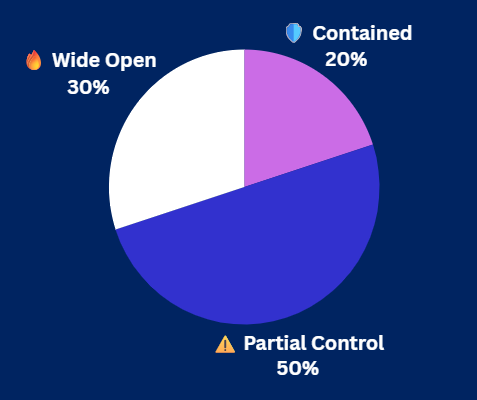
How confident are you in your cloud security posture right now? |
|
|
Yesterday's Pulse Check Results |
If an infostealer hit one employee's laptop today… |
|
|
Security Tools You Can Use |
|
|
Ingress-Nginx Bug Exposes Kubernetes Clusters |
A vulnerability in ingress-nginx could allow authenticated attackers to execute arbitrary code and access Kubernetes Secrets in affected clusters. The risk is amplified because ingress-nginx often runs with elevated privileges and cluster-wide Secret access, expanding the blast radius if exploited. |
Patches have been released for the vulnerability.
Patch ingress-nginx immediately, lock down Ingress and RBAC permissions, monitor for anomalous configuration changes, and test incident response plans. |
Shadow AI Puts Enterprise Data at Risk |
Shadow AI use is quietly spreading across enterprises, exposing sensitive data and creating new security and compliance blind spots.
As employees, including senior leaders, adopt unsanctioned AI tools to move faster, sensitive data is often shared outside organizational control, leaving security teams with limited visibility. Andy Sambandam of Clarip warned that prioritizing speed over governance is driving risky, unauthorized AI use, while Sprinto CEO Girish Redekar noted that shadow AI undermines frameworks like GDPR by breaking data traceability.
Implement real-time AI governance with approved GenAI platforms, strong data controls, centralized logging, and tested incident response plans to keep unsanctioned AI use from exposing sensitive enterprise data. |
|
|
How Secure is Your Kubernetes Environment? |
Kubernetes environments continue to grow in complexity and exposure, making them attractive targets for attackers. Misconfigurations, excessive permissions, and limited visibility can quickly turn a single flaw into a cluster-wide incident, putting applications, data, and cloud resources at risk. |
How to secure your Kubernetes clusters: |
- Enforce least-privilege access and privileged access management by tightly controlling RBAC, service accounts, and administrative credentials to limit blast radius if access is abused.
-
Reduce attack paths by hardening cluster entry points, scanning container images before deployment, and applying network segmentation to prevent external compromise and lateral movement.
-
Improve detection and response by monitoring runtime behavior and enabling centralized audit logging to quickly identify and investigate suspicious activity.
|
Effective Kubernetes security relies on layered controls across access, networking, workloads, and visibility to reduce risk, improve detection, and support reliable operations at scale. |
|
|
| Ken Underhill is an award-winning cybersecurity professional, bestselling author, and seasoned IT professional. He holds a graduate degree in cybersecurity and information assurance from Western Governors University, bringing years of hands-on experience to the field.
|
|
|
Cybersecurity Insider is a TechnologyAdvice business |
© 2026 TechnologyAdvice, LLC. All rights reserved. |
TechnologyAdvice, 3343 Perimeter Hill Dr., Suite 215, Nashville, TN 37211, USA. |
|
|
|