It’s time to lock in, Digital Defenders! 🛡️ |
Today’s cyber pulse is spiking—from a massive healthcare breach leaking millions of patient records to Google raising red flags about a shadowy attack campaign targeting the insurance industry. Meanwhile, OpenAI has just inked a game-changing $200 million deal with the US government. AI isn’t just reshaping your workday. It’s rewriting national security.
Before you dive in: The Neuron just dropped its revamped podcast—and it’s asking the big question: Will AI wipe out half of all white-collar jobs? We unpack the data, dodge the hype, and get smart insights from Microsoft’s Alexia Cambon on how to stay ahead in an AI-saturated workday.
Tune in on Spotify or wherever you get your podcasts! Or watch it on YouTube! |
|
| Here’s what you need to know: |
|
|
Healthcare Hit Hard: 5.41M Records Leaked in Episource Cyberattack |
Episource, a medical coding firm used by healthcare providers, has been hit with a cyberattack that may have exposed the personal data of over 5.41 million individuals. |
The firm detected suspicious activity on its systems between January 27 and February 6. Following an investigation, it was determined that a threat actor accessed and copied sensitive data such as health insurance data, Medicaid-Medicare government payor ID numbers, medical record numbers, doctors, diagnoses, and test results. Episource has stated that it has taken steps to mitigate the incident and is working closely with law enforcement to respond to the breach. Episource’s recommendation: Review your benefits statements carefully and watch out for fake health providers aiming to steal personal data. |
Google Warns: Scattered Spider Group Targeting IT Teams For US Insurance Providers |
Google’s Threat Intelligence Group (GTIG) has warned organizations in the insurance industry of possible cyberattacks and social engineering schemes from the Scattered Spider (UNC3944) cybercrime group, following several incidents reminiscent of their past activity.
According to The Hacker News, the group has a history of targeting managed service providers and outsourced IT teams by impersonating employees and bypassing MFA. IT Managers: Use this as a reminder to review your access controls and retrain staff on social engineering red flags. |
OpenAI Wins $200M Contract with US Department of Defense |
OpenAI was awarded a $200 million contract with the US Department of Defense on June 17, enabling the use of OpenAI’s AI products in the department’s administrative and security efforts.
The contract consolidates all of OpenAI’s public sector products under OpenAI for Government, covering ChatGPT Gov and its other existing partnerships with NASA, the US National Labs, the Air Force Research Laboratory, among others. OpenAI says that custom AI models for national security will also be made available, albeit “on a limited basis.”
As AI enters the realm of national security, closely monitor its development to ensure these models align with established compliance and security standards. |
|
|
How comfortable are you with AI stepping into national security? |
|
|
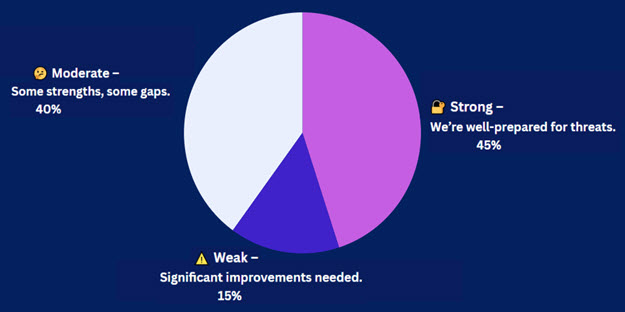
Yesterday's Pulse Check Results |
How secure is your organization’s cybersecurity posture? |
|
|
‘Hacklink’ Black Market Fuels Rise in SEO Poisoning Attacks and Scam Content |
The black market platform ‘Hacklink’ has been linked to a rise in SEO poisoning attacks, with threat actors injecting malicious links into thousands of websites to push scam content to the top of Google search results. |
As reported on Infosecurity Magazine, the tactic was uncovered by researchers at Netcraft, who identified online gambling platforms as primary targets of the scheme. The Hacklink marketplace allows cybercriminals to purchase compromised websites and inject hidden JavaScript code that influences search engine crawlers.
This manipulation allows phishing domains and scam pages to rank higher in Google Search, sometimes even outranking legitimate brands and websites. Web Admin Tip: Regularly scan your website for unauthorized JavaScript and monitor for unusual traffic spikes. |
Asana: New MCP Feature Causes Data Leak to Other Asana Users |
Asana has notified its users of a security flaw in its new, AI-powered Model Context Protocol (MCP) server, stating that the bug could potentially leak customer data to other organizations.
According to Bleeping Computer, the data leak was caused not by a cyberattack but rather a logic flaw in the MCP system that exposed data from Asana instances to other MCP users. Among the possible information exposed were chatbot-generated queries, project metadata, task-level data, and team details.
The MCP feature was temporarily taken offline following the incident but has since been restored. For Asana MCP users, it might be a good idea to hold off using MCP for now. |
Veeam Patches Critical Flaw That Could Lead To Remote Code Execution |
Data backup provider Veeam has released a set of patches for its Backup and Replication service, addressing CVE-2025-23121—a critical vulnerability that could allow remote code execution (RCE).
According to The Hacker News, the flaw carries a 9.9 CVSS score and enables remote code execution (RCE) on the Backup Server when exploited by an authenticated domain user. Veeam confirmed that all earlier version 12 builds, including 12.3.1.1139, are affected.
The update resolves a second issue, CVE-2025-24286 (with a 7.2 CVSS), which allows an authenticated user with the Backup Operator role to modify backup jobs, potentially leading to arbitrary code execution. If your organization uses Veeam’s Backup & Replication software, apply these patches immediately. |
|
|
Why Small Businesses Need Big Security |
Small doesn’t mean safe. Many small businesses assume they’re flying under hackers’ radar, but that false sense of security can be costly. Experts at eSecurityPlanet warn that threat actors often target smaller organizations precisely because they tend to have fewer defenses and limited security resources. |
Source: eSecurityPlanet YouTube |
Here are some recommendations to consider: |
- Implement basic network security, such as implementing firewalls and managing admin-level access
- Update software regularly, particularly operating systems, applications, and other programs used in your business.
-
Invest in employee training to equip them to handle phishing scams and social engineering tactics.
- Use strong and unique passwords, or consider using a password manager for even stronger overall password protection.
|
Small or large, every business needs to keep cybersecurity front and center to stay secure and resilient from whatever comes their way. |
|
|
| Senior Staff Writer at TechnologyAdvice |
Luis Millares is a seasoned tech writer with broad experience reviewing consumer gadgets and enterprise software, offering clear, reliable insights across the latest in technology. |
|
|
Into more than just malware and mayhem?
|
Stay sharp on AI, cloud, DevOps, and the tech players shaking things up. Subscribe to Daily Tech Insider for no-fluff rundowns and witty breakdowns delivered straight to your inbox—because knowing what’s next helps you stay secure. |
|
|
Into more than just malware and mayhem? |
Stay sharp on AI, cloud, DevOps, and the tech players shaking things up. Subscribe to Daily Tech Insider for no-fluff rundowns and witty breakdowns delivered straight to your inbox—because knowing what’s next helps you stay secure. |
|
|
Cybersecurity Insider is a TechnologyAdvice business |
© 2025 TechnologyAdvice, LLC. All rights reserved. |
TechnologyAdvice, 3343 Perimeter Hill Dr., Suite 100, Nashville, TN 37211, USA. |
|
|
|